How to Sell Collectibles Online in Malaysia: Complete Seller Guide
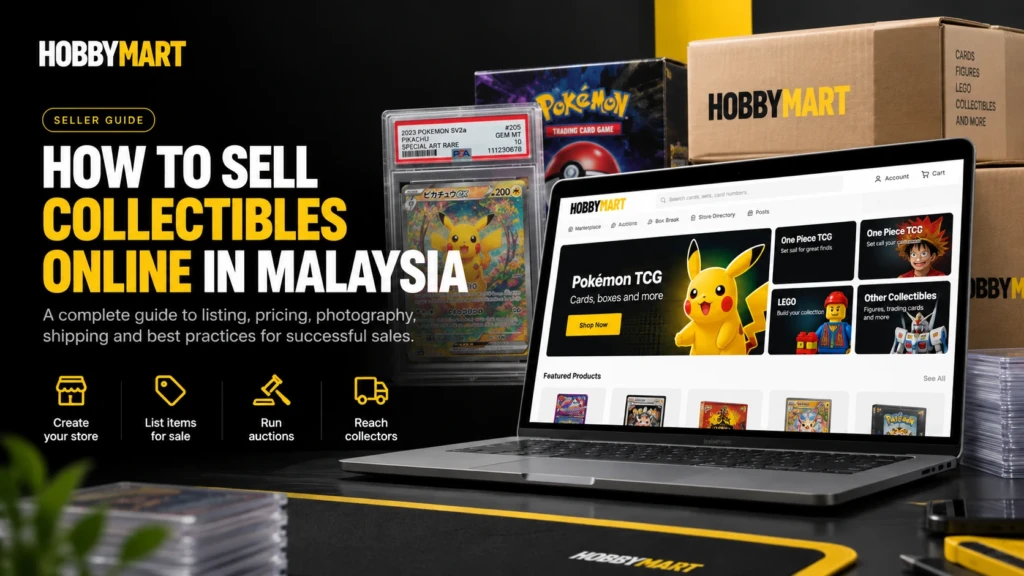
Selling Collectibles Online in Malaysia
Selling collectibles online has become one of the easiest ways for Malaysian collectors to turn duplicates, unwanted items or existing inventory into sales.
But simply uploading a photo and writing “WTS” does not necessarily result in a sale.
Whether you are selling Pokémon cards, One Piece TCG, graded cards, sealed products, LEGO or other collectibles, the quality of your listing, pricing, photographs and seller reputation can make a significant difference.
This guide explains how to sell collectibles online in Malaysia, how to create better listings, and the best practices that can help buyers feel confident purchasing from you.
HobbyMart is a Malaysian collectibles marketplace where hobbyists and professional sellers can create their own store, list items at fixed prices or create auctions.
What Collectibles Can You Sell Online?
The Malaysian collectibles market covers far more than individual trading cards.
Common products sold online include:
Pokémon TCG cards
One Piece TCG cards
Other trading card games
PSA, CGC and BGS graded cards
Raw trading cards
Booster packs
Booster boxes
Elite Trainer Boxes
Collection boxes
Sealed TCG products
LEGO sets
Figures and hobby collectibles
Vintage collectibles
Complete or partial collections
You do not necessarily need to operate a hobby shop to start selling.
Some sellers have hundreds of products. Others simply want to sell a duplicate card or sealed product from their personal collection.
Both can use an online collectibles marketplace.
Step 1: Know Exactly What You Are Selling
The first rule of selling collectibles is simple:
Identify the item accurately.
For trading cards, try to determine:
Character or card name
Card number
Set
Language
Rarity
Condition
Edition or variation
Grading company and grade, if applicable
For example, instead of listing:
Pikachu card
a much better listing title would be:
Pikachu TG05/TG30 – Lost Origin – English – Near Mint
For a graded card:
Charizard ex 199/165 – Pokémon 151 – PSA 10
For a sealed product:
Pokémon Surging Sparks Elite Trainer Box – English – Sealed
The more accurately the product is identified, the easier it becomes for both buyers and search engines to understand the listing.
Step 2: Research the Market Before Setting Your Price
One of the biggest mistakes new collectible sellers make is using the highest asking price they can find as the value of their item.
Someone listing a card for RM1,000 does not mean somebody has actually bought it for RM1,000.
Where possible, look at:
Recent sold prices
Current listings
Malaysian market prices
International market references
Card condition
Language
Grade
Product availability
Make sure you are comparing the same collectible.
For example, the prices of these can be very different:
Raw Near Mint
PSA 9
PSA 10
The Japanese and English versions of the same Pokémon card may also have completely different market values.
Price for your objective
Ask yourself what you want.
If you want a faster sale, competitive pricing usually helps.
If you are prepared to wait for your desired price, you can price higher.
Neither approach is necessarily wrong.
The mistake is pricing significantly above the market while expecting the item to sell quickly.
Step 3: Decide Between a Fixed-Price Listing and an Auction
There are two common ways to sell collectibles online.
Fixed-Price Listings
You set a price and the buyer decides whether to purchase.
For example:
RM150
Fixed pricing works well when:
The item has an established market value
You already know the minimum price you want
There are many comparable products
You are willing to wait for the right buyer
Auctions
With an auction, buyers compete by placing bids until the auction closes.
Auctions can work well for:
Popular collectibles
Rare items
High-demand cards
Unique products
Items that are difficult to price
Products where several buyers may be interested
HobbyMart supports both fixed-price listings and online auctions for collectibles in Malaysia.
One important auction rule:
Never start an auction below a price you are genuinely prepared to accept.
A low starting bid may attract attention, but the final price is never guaranteed.
Step 4: Create a Search-Friendly Product Title
A product title should describe the item rather than advertise it.
Avoid titles such as:
MUST BUY!!! VERY RARE PIKACHU!!!
Instead, use information buyers are actually searching for.
For example:
Pikachu 173/165 – Pokémon 151 – English – Near Mint
or:
Umbreon VMAX 215/203 – Evolving Skies – PSA 10
A useful formula for trading cards is:
Card Name + Card Number + Set + Language + Condition/Grade
For sealed products:
Product Name + Set + Language + Sealed
Clear titles help buyers browsing HobbyMart and may also help individual product pages appear for more specific Google searches.
Step 5: Take Clear Photos of the Actual Item
Collectibles are condition-sensitive.
Good photographs can therefore be one of the most important parts of an online listing.
You do not need expensive camera equipment. A modern smartphone, good lighting and a clean background are usually enough.
Raw trading cards
Photograph:
Full front
Full back
Corners
Edges
Surface where necessary
Visible defects
Graded cards
Show:
Full front of slab
Full back
Grading label
Certification information
Scratches or damage to the slab, if relevant
Sealed products
Show:
Front
Back
Sides
Seals
Corners
Tears
Dents
Damage
Whenever possible, use photographs of the actual item being sold.
A buyer wants to know what will arrive at their door.
Step 6: Describe the Condition Honestly
Trying to hide a defect may help get someone to click Buy, but it can create a much bigger problem afterwards.
If a card has whitening, show it.
If a sealed box has a dent, mention it.
If a slab has scratches, disclose them.
Experienced collectors understand that collectibles are not always perfect.
Accurate descriptions reduce misunderstandings and build trust between buyers and sellers.
For raw trading cards, avoid inventing grades such as:
Mint++++
Use commonly understood condition descriptions and let your photographs support the condition you have selected.
Step 7: Write a Useful Product Description
Your description should answer the questions a buyer would otherwise need to message you about.
For a trading card, consider including:
Card: Pikachu 173/165
Set: Pokémon 151
Language: English
Condition: Near Mint
Notes: Please refer to photographs for actual card condition.
For a sealed product:
Product: Surging Sparks Elite Trainer Box
Language: English
Condition: Factory sealed
Notes: Actual item shown. Please check photographs for box condition.
Keep descriptions clear and factual.
A useful listing usually converts better than a description containing nothing except:
PM if interested.
Step 8: Think About the Buyer's Total Cost
Buyers do not evaluate only the selling price.
They evaluate:
Item Price + Shipping = Total Cost
This becomes especially important for inexpensive collectibles.
A RM10 card with an unreasonable shipping charge may be less attractive than a slightly more expensive card with better combined shipping options.
For sellers carrying multiple cards or products, having a larger catalogue can also help.
Someone who discovers one card in your store may find several other cards they need at the same time.
This is one reason building a proper online store can be more useful than continually posting individual WTS messages.
Step 9: Build Your HobbyMart Store
Instead of thinking about HobbyMart as somewhere to upload one item, think of your seller page as your online collectibles catalogue.
A customer can visit your store and browse what you currently have available.
For regular sellers, this can be much more efficient than repeatedly sending buyers individual photographs through WhatsApp or reposting the same inventory on social media.
HobbyMart currently features stores selling dozens of collectibles, including Pokémon cards, sealed products and other hobby items.
The more relevant inventory you list, the more opportunities buyers have to discover something they want.
Step 10: Keep Your Inventory Accurate
Many collectible sellers use several channels at once.
You might sell through:
HobbyMart
Facebook
WhatsApp
Physical stores
Hobby events
Other marketplaces
That is perfectly reasonable.
However, if an item sells somewhere else, remember to update your online inventory.
Few things frustrate buyers more than purchasing a product only to discover it was already sold elsewhere.
As your store becomes larger, inventory management becomes increasingly important.
Step 11: Pack Collectibles Properly
Making the sale is only half the job.
The product still needs to reach the buyer safely.
Packing raw cards
A common method is:
Card → Sleeve → Rigid Protection → Protective Packaging → Mailer/Box
More expensive cards should receive additional protection.
Packing graded cards
Protect slabs against:
Scratches
Impact
Movement inside the parcel
Use sufficient cushioning and an appropriately sized box.
Packing sealed products
Sealed collectors may care about the box almost as much as the contents.
Protect:
Corners
Shrink wrap
Seals
Packaging surfaces
Use a sturdy carton and sufficient cushioning to prevent movement.
Do not assume that because the cards inside a box are unharmed, damage to the sealed product does not matter.
For sealed collectors, packaging condition can affect value.
Step 12: Ship Promptly and Keep Records
After receiving an order:
Verify the item.
Photograph it where appropriate.
Pack it securely.
Ship within the required timeframe.
Keep the tracking number.
Retain proof of shipment.
For expensive collectibles, keeping additional photographs of the item and packaging before shipment can also be useful.
Good sellers do not consider a transaction complete simply because payment has been made.
The job is complete when the buyer receives what was described.
Step 13: Build a Reputation as a Seller
Trust becomes increasingly valuable as you sell more collectibles.
A good seller consistently:
Uses accurate photographs
Describes items honestly
Prices reasonably
Keeps inventory updated
Packs products properly
Ships promptly
Communicates professionally
Resolves genuine problems responsibly
A buyer who receives exactly what they expected is much more likely to buy from you again.
Over time, customers may begin browsing your store directly rather than discovering you through a single listing.
That is how an occasional seller starts building a customer base.
Best Practices for Selling Pokémon Cards
Pokémon TCG is one of the largest collectible categories in Malaysia.
When listing Pokémon cards, include the exact:
Pokémon name
Card number
Expansion
Language
Condition
Grade, if applicable
Collectors searching for an exact card often search using combinations such as:
Pikachu TG17
Charizard PSA 10 Malaysia
Umbreon Evolving Skies
Pokémon 151 cards Malaysia
Detailed listings make it easier for the right collector to find the right card.
Best Practices for Selling Graded Cards
For PSA, CGC, BGS and other graded collectibles, include the grading company and grade directly in the listing title.
For example:
Pikachu 173/165 Pokémon 151 PSA 10
rather than:
Graded Pikachu
Photograph the slab clearly enough for buyers to inspect both the card and holder.
Where appropriate, include the certification number so buyers can independently verify the grade.
Best Practices for Selling Sealed Products
For sealed collectibles, condition is particularly important.
Specify whether the product is:
Factory sealed
Opened
Damaged
Display condition
Dented
Torn
Missing shrink wrap
Photograph all sides for expensive sealed products.
A collector buying an item to display or keep sealed may evaluate condition very differently from somebody buying it simply to open.
Common Mistakes That Make Collectibles Harder to Sell
Asking too much because of one expensive listing
Look at realistic market values rather than the highest price you can find online.
Poor photographs
Dark, blurry or incomplete photographs create uncertainty.
Vague titles
“Pokemon card for sale” tells the buyer very little.
Hiding defects
A disclosed defect is usually easier to deal with than an unhappy buyer who discovers it later.
Having only one or two listings
If you regularly sell collectibles, gradually build your store so buyers have more products to browse.
Ignoring shipping costs
Buyers compare the final amount they need to pay.
Leaving sold inventory online
Keep your available products accurate.
Should You Use HobbyMart and Social Media Together?
Yes.
You do not have to stop using Facebook groups, WhatsApp communities, Telegram or social media.
Those communities remain important parts of the Malaysian hobby market.
Instead, use them together.
Social media can generate awareness.
Your HobbyMart store can provide buyers with a structured place to:
Browse your inventory
View photographs
Check prices
Purchase products
Participate in auctions
Complete payment securely
Instead of continually reposting every product, you can also direct interested collectors to your online store.
Frequently Asked Questions
Where can I sell collectibles online in Malaysia?
Malaysian sellers can use specialist collectible marketplaces, general e-commerce platforms, social media groups and hobby communities. HobbyMart.my is a Malaysia-focused collectibles marketplace for categories including Pokémon TCG, One Piece TCG, graded cards, LEGO and other collectibles.
Can I sell Pokémon cards online in Malaysia?
Yes. Raw Pokémon cards, graded cards, sealed products and collections can all be sold online. Accurate identification, photographs, condition descriptions and competitive pricing can improve your chances of finding a buyer.
Can I sell graded cards on HobbyMart?
Yes. Graded cards are one of the collectible categories available through HobbyMart.
Can I auction collectibles online in Malaysia?
Yes. HobbyMart supports live auction listings in addition to normal fixed-price marketplace listings.
Do I need a shop to sell on HobbyMart?
No. HobbyMart is intended for both collectors selling personal items and more established sellers operating larger stores.
How do I make my collectible listing sell faster?
Use competitive pricing, descriptive titles, clear photographs, accurate condition information, reasonable shipping and a complete product description. Building a larger catalogue can also give buyers more reasons to browse your store.
Should I use actual photos when selling collectibles?
Whenever practical, yes. Because condition can significantly affect collectible value, buyers generally benefit from seeing photographs of the actual product they will receive.
Is a fixed price or auction better?
Fixed-price listings are useful when you know the amount you want. Auctions can work well for collectibles with strong demand or items where several buyers may compete. The better option depends on the item and your selling objective.
Start Selling Collectibles Online in Malaysia
You do not need hundreds of products to become a seller.
Start with one.
Take clear photographs.
Identify the product accurately.
Research the price.
Write an honest description.
Then put it in front of collectors.
Whether you are selling a duplicate Pokémon card, a graded slab, sealed TCG product, LEGO set or an entire collection, HobbyMart gives Malaysian collectors and sellers a dedicated marketplace to buy, sell and auction collectibles.
Create your HobbyMart store and start listing your collectibles today.
Buy. Sell. Auction. HobbyMart.