Where to Buy TCG Cards in Malaysia: How to Find the Best Deals Online
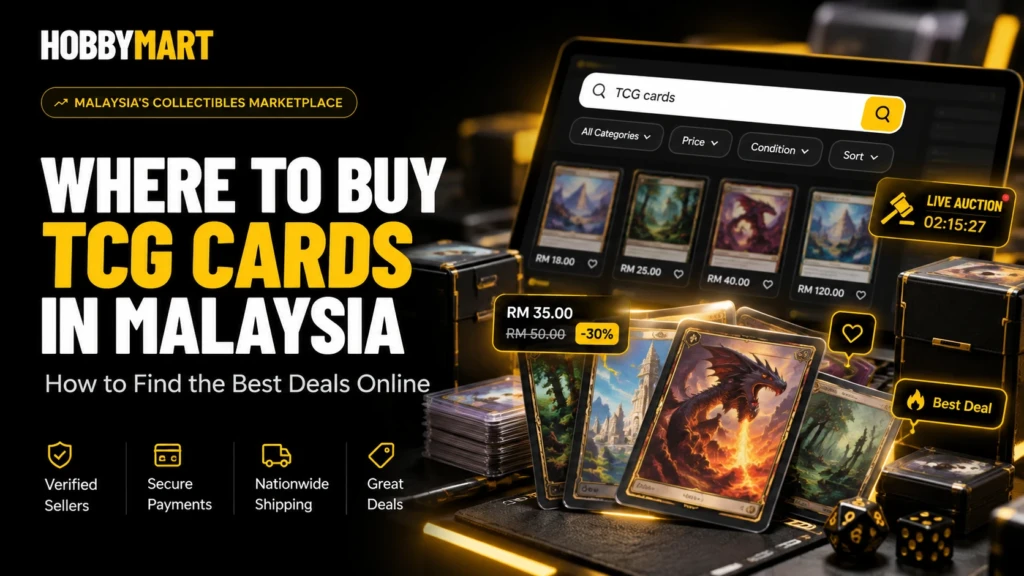
Where to Buy TCG Cards in Malaysia: How to Find the Best Deals Online
Buying TCG cards online is easy. Finding a genuinely good deal is harder.
Whether you collect Pokémon, One Piece, Gundam, sports cards or other trading cards, prices can vary significantly between sellers, marketplaces and even different versions of the same card.
The best deal is not always the cheapest listing.
It is usually the combination of the right card, the right condition, the right seller and the right price.
If you are buying TCG cards in Malaysia, here are some practical ways to find better deals online.
1. Use Search, Filters and Sorting Properly
One of the easiest ways to miss a good deal is to browse a marketplace without narrowing down what you actually want.
Start with search if you already know the card, character, set or product you are looking for.
Then use filters to reduce the number of irrelevant listings.
Useful filters may include:
Category
Price range
Condition
Graded or ungraded
Product type
Language
Availability
Once you have narrowed down the results, use sorting to look at the marketplace differently.
Useful sorting options may include:
Price: Low to High
Price: High to Low
Newest Listings
Most Relevant
Ending Soon for auctions
If you are looking for value, Price: Low to High is an obvious place to start.
But do not stop there.
Checking Newest Listings can help you find attractive items before other buyers notice them.
For auctions, Ending Soon can help you focus on listings where the final price is about to be decided.
The combination of search + filter + sort is far more effective than simply scrolling through hundreds of products.
2. Compare Similar Listings Before You Buy
Never assume the first listing you see represents the market price.
The same card can be listed at very different prices depending on:
Condition
Language
Set
Card number
Edition
Raw or graded
Grade
Seller
Shipping cost
Search for the same card and compare multiple listings before buying.
A marketplace with several sellers gives buyers an advantage because you can compare prices without jumping between different shops.
Sometimes paying slightly more for a cleaner card or a better seller can represent better value than buying the cheapest listing available.
3. Use a TCG Price-Checking App Before You Buy
If you do not know roughly what a card is worth, it is much harder to know whether you have found a good deal.
Price-checking apps can help.
Apps such as Shiny allow collectors to check current and historical card prices and compare data from major marketplaces.
For collectors who frequently buy cards, Shiny Pro also includes scanning capabilities, which can make it faster to identify a card and check its approximate market value.
This can be especially useful when:
Browsing marketplace listings
Comparing several copies of the same card
Buying at physical events
Evaluating collections
Checking unfamiliar cards
Looking through a large number of singles
However, price apps should always be treated as a reference, not an absolute answer.
The actual value of a card can still depend on:
Condition
Centering
Language
Local demand
Availability
Grading company
Grade
Use price data to guide your decision, then compare it against the actual listing in front of you.
4. Check Newly Listed Items Regularly
Some good deals disappear quickly.
A seller may list something below the usual market price because they want a fast sale, are clearing part of their collection or simply value the item differently from other sellers.
Checking newly listed items gives you a better chance of seeing these opportunities before other collectors do.
Instead of searching only for one exact card, browse recent listings regularly.
You may find:
A card you were already planning to buy
An unexpectedly good price
A seller clearing multiple items
A less popular card with strong value
A sealed product listed below typical asking prices
Sometimes the best deal is the one you were not originally looking for.
5. Use Auctions Strategically
Auctions can be one of the best ways to find attractive TCG deals, but only if you approach them with discipline.
Before bidding, decide the maximum amount you are genuinely willing to pay.
That amount should take into account:
Approximate market value
Card condition
Shipping cost
How much you personally want the item
Whether similar cards are available elsewhere
Once you have decided your limit, stick to it.
Do not keep increasing your bid just because another buyer has outbid you.
A good deal can quickly become an expensive purchase when bidding becomes emotional.
If the marketplace supports maximum bidding or automatic bidding, enter the highest amount you are comfortable paying and let the system increase your bid incrementally when necessary.
Another useful strategy is to bid on more than one suitable item.
If several copies of the same card are available, or several cards would fit your collection equally well, placing reasonable maximum bids on multiple auctions can improve your chances of winning at least one item at a good price.
This is often better than becoming overly focused on winning one particular auction.
A simple approach is:
Know the market value → Set your maximum bid → Bid on several suitable opportunities → Let overpriced auctions go
The goal is not to win every auction.
The goal is to win the right item at the right price.
6. Compare Raw Cards With Graded Cards
Collectors sometimes assume graded cards are always much more expensive.
That is not necessarily true.
Depending on the card, a PSA 9 or equivalent graded copy may sometimes be priced surprisingly close to a clean raw card.
When comparing listings, look at:
Raw card price
versus
Graded card price
Then decide whether the difference makes sense for you.
A graded card may offer:
Third-party authentication
A confirmed grade
Better protection
Easier condition comparison
Potentially easier resale
On the other hand, raw cards can offer better value for collectors who are comfortable evaluating condition themselves.
If you enjoy grading cards, a clean raw copy with strong centering may also be more interesting than buying an already graded slab.
There is no single correct answer.
The important thing is to compare both options before buying.
7. Look Beyond the Most Popular Chase Cards
The most popular cards naturally attract the most buyers.
That often means more competition and higher asking prices.
You may find better value by looking beyond the obvious chase cards.
Consider exploring:
Illustration Rares
Special Illustration Rares
Older promotional cards
Japanese releases
Less-hyped sets
PSA 9 slabs
Alternative artworks
Less popular characters
Recently released cards that have fallen from launch prices
There is nothing wrong with buying the biggest chase cards.
But collectors who only look at the most popular cards may overlook much better value elsewhere.
8. Judge the Whole Deal, Not Just the Asking Price
The cheapest listing is not always the best deal.
Imagine two copies of the same card:
Card A — RM100
Visible whitening, poor photos and uncertain condition.
Card B — RM120
Clean condition, detailed photos and a reputable seller.
For many collectors, Card B may be the better purchase.
When comparing listings, consider the complete transaction:
Card condition
Photo quality
Seller reputation
Shipping charges
Payment security
Authenticity
Buyer protection
Saving RM20 does not mean much if the card arrives in worse condition than expected.
A good deal is about value, not simply the lowest number on the page.
Where to Buy TCG Cards Online in Malaysia
Malaysian collectors now have several ways to buy trading cards online.
General Marketplaces
Large e-commerce platforms can offer a huge selection.
The downside is that TCG products are mixed together with thousands of unrelated items, which can make specialist browsing and comparison less convenient.
Social Media Groups
Facebook groups and collector communities can be useful for finding cards.
However, many transactions are arranged manually, so buyers need to be more careful about:
Seller reputation
Payment methods
Authenticity
Shipping
Dispute protection
Local Card Shops
Card shops remain a strong option, particularly for:
New releases
Sealed products
Organised play
Community events
The main limitation is that every shop has its own inventory.
Dedicated TCG Marketplaces
A dedicated TCG marketplace brings listings from multiple collectors and sellers into one place.
This makes it easier to:
Search for specific cards
Filter by category and price
Sort by newest or lowest price
Compare multiple sellers
Find graded and raw cards
Browse sealed products
Discover live auctions
Spot new opportunities quickly
For buyers who actively hunt for value, these tools can make the marketplace experience much more efficient.
Find TCG Deals on HobbyMart
HobbyMart is a Malaysian marketplace built for TCG cards and collectibles.
Buyers can browse products from multiple sellers across categories such as:
Pokémon
One Piece
Gundam
Graded cards
Raw singles
Sealed products
Sports cards
Other collectibles
Use HobbyMart's search, filters and sorting options to narrow down what you want and compare listings more efficiently.
You can also browse live auctions, set your maximum bid and watch multiple opportunities instead of relying on a single listing.
Browse the HobbyMart Marketplace
https://hobbymart.my/listing
Browse Live Auctions
https://hobbymart.my/auctions
The best TCG deal is not always the cheapest card.
It is the item you actually want, in the condition you expect, at a price that makes sense — from a transaction you can buy with confidence.